 Bliss HQ
Year-end checklist for bookkeeping clients (with client email templates)
A November to January year-end plan for bookkeeping firms: what to request from clients, what to reconcile and clean up, 1099 prep under the new $2,000 threshold, and a clean package for the CPA, with two copy-and-paste email templates.
Year-end is the one close every client and every CPA cares about. The books you hand over in January become the tax return, and anything left open in December turns into a scramble in February, when the CPA is busiest and least patient.
The firms that get through it calmly do not work harder in January. They start in November, ask clients for everything in one go, and treat the year-end as a set of jobs with dates, not a pile of loose ends.
This is the year-end checklist we run for our own clients, in the order we run it.
We are bookkeepers, not CPAs. Nothing here is tax advice. Anything about tax treatment belongs on the list for the client's CPA or tax preparer to review.
The timeline at a glance
| When | What happens |
|---|---|
| Early November | Send every client the year-end request list. Start collecting W-9s. |
| Late November to mid-December | Catch up and reconcile everything through November. Clean the balance sheet. |
| Early January | Close December, reconcile through December 31, prepare 1099s and the CPA package. |
| By February 1, 2027 | 1099-NEC forms to contractors and the IRS (January 31 falls on a Sunday). |
| Late January to February | Send the CPA package, post the CPA's adjusting entries, lock the year. |
Agree a "books ready" date with each client's CPA now. It turns "as soon as possible" into a real deadline your whole team can plan around.
1. Send the year-end request list in November
Most year-end delays are a missing statement, a contractor with no W-9 or an asset nobody mentioned. Ask for all of it once, early, in a single list, and let the reminders do the chasing.
Ask every client for:
- Bank, credit card and loan statements through December 31, including accounts with no live feed.
- A W-9 for every contractor or vendor they paid this year who may need a 1099.
- Anything they bought or sold that was large: equipment, vehicles, property.
- New loans, refinanced loans or lines of credit.
- Personal money put into the business, or business money taken out, that you might not know about.
- An inventory count as of December 31, if they hold stock.
- Their CPA's name and email, and whether the CPA has their own request list.
Client email template: the year-end request
Subject: Getting your [YEAR] books ready for your tax return Hi [FIRST NAME], Year-end is coming up, and we want your books ready for [CPA NAME] by [BOOKS READY DATE], so there's no rush in February. We've put everything we need in one list in your client portal: [PORTAL LINK]. Most of it takes a few minutes, and you can upload documents straight from your phone. The two things that matter most: 1. December statements for every bank, credit card and loan account, as soon as they arrive. 2. A W-9 for any contractor you paid this year, so we can prepare 1099s on time. If anything big happened this year, like buying equipment, taking out a loan or hiring help, just reply and tell us. A short note now saves a lot of back and forth later. We're bookkeepers, not tax professionals, so questions about how something is taxed should go to [CPA NAME]. We'll make sure they have everything they need from the books. Thanks, [YOUR NAME]
2. Reconcile every account through year-end
The CPA will build the return from your balance sheet, so every balance on it has to be right on December 31.
- Reconcile every bank and credit card account through the December statement.
- Tie each loan balance to the lender's year-end statement and split payments between principal and interest.
- Review uncleared items older than 60 days. Old uncleared checks and deposits are a common reason the reconciliation is "done" but the balance is still wrong.
- Confirm merchant and payment platform payouts (Stripe, Square, Shopify, PayPal) match the platform's own year-end report.
If the books are messy enough that reconciling feels impossible, treat it as a cleanup, not a close. Our bookkeeping cleanup checklist walks through it.
3. Clean the balance sheet
Clear the accounts a CPA should never have to ask about:
- Suspense, Uncategorized and Ask My Accountant: zero, or every line explained.
- Opening Balance Equity: zero once the file is set up.
- Undeposited Funds: empty, or only real deposits in transit at December 31.
- Accounts receivable and payable: match open invoices and bills, with stale items reviewed. Write-offs are a client decision; list them for the CPA.
- Payroll liabilities: should clear each quarter, and the year's payroll should tie to the payroll provider's reports.
- Owner contributions and draws: posted to equity accounts, not expenses.
- Fixed assets: list anything bought or sold this year, with date, cost and a copy of the invoice. Depreciation and how assets are treated is for the CPA.
4. Prepare for 1099s early
1099s have the hardest deadline of the year-end, and the most common problem is a missing W-9 in late January.
- The threshold changed. For payments made in 2026, the reporting threshold for Form 1099-NEC and most 1099-MISC payments rose from $600 to $2,000. If you have a vendor list built on the old $600 rule, update it, and have the client's CPA confirm anything you're unsure about.
- Collect W-9s now, not in January. Send the request with the year-end list and follow up in December.
- Run a vendor payments report for the year, and mark which vendors are likely to need a 1099. Payments by card or through a payment platform are generally reported by the processor instead, so check how each vendor was paid.
- Know the deadline. 1099-NEC forms go to contractors and the IRS by January 31. In 2027 that falls on a Sunday, so the date is Monday, February 1.
If your firm files 1099s for clients, treat it as its own job with its own steps and dates, not a line inside the year-end close.
5. Count inventory on December 31
If the client holds stock, the year-end count is the number the cost of goods sold depends on. Ask for the count, the method used and who did it. If the inventory account has never been relieved through the year, flag it for the CPA instead of making a large adjustment on your own.
6. Build the CPA package
Send the CPA one tidy package instead of a trickle of emails and logins. A good package includes:
- Year-end Balance Sheet, Profit and Loss (with the prior year beside it) and General Ledger.
- Bank, credit card and loan reconciliations at December 31, with the statements.
- Fixed asset additions and disposals, with invoices.
- Loan statements showing year-end balances and interest paid.
- Payroll year-end reports.
- The 1099 summary.
- Your list of open items and anything for the CPA to review, such as large write-offs, owner draws and personal spending found in the books.
Email template: the CPA hand-off
Subject: [CLIENT NAME] books for [YEAR] are ready Hi [CPA NAME], [CLIENT NAME]'s books for [YEAR] are closed and reconciled through December 31. The year-end package is here: [LINK]. It includes the balance sheet, P&L with prior-year comparison, general ledger, all reconciliations with statements, fixed asset changes, loan statements, payroll reports and the 1099 summary. We've listed a few items for your review on the last page, including [ONE OR TWO KEY ITEMS]. Once you've finished, please send any adjusting entries and we'll post them and lock the year. Thanks, [YOUR NAME]
A clean package is also the best introduction to a CPA you'd like referrals from. If you're building those relationships, our guide to getting bookkeeping clients from CPA referrals shows how to turn it into a two-way partnership.
7. Post the CPA's adjustments and lock the year
The year is not finished when you send the package. It is finished when the CPA's adjusting entries are in the books and the year is locked.
- Post the CPA's adjusting journal entries, dated December 31, and attach their workpaper.
- Check that retained earnings rolled forward as expected on January 1.
- Lock the year in QuickBooks Online or Xero so nothing changes behind you.
- Send the client their final year-end reports.
How to run year-end for every client at once
The checklist is the easy part. The hard part is running it for 30 or 80 clients at the same time, with each one at a different step and waiting on a different person. Three things make it manageable:
- A year-end job for every client, from the same template. In Bliss HQ, the Year-End Close and CPA Package and 1099 Filing starter templates give every client the same steps and due dates, so your team can see who is behind at a glance. See recurring jobs.
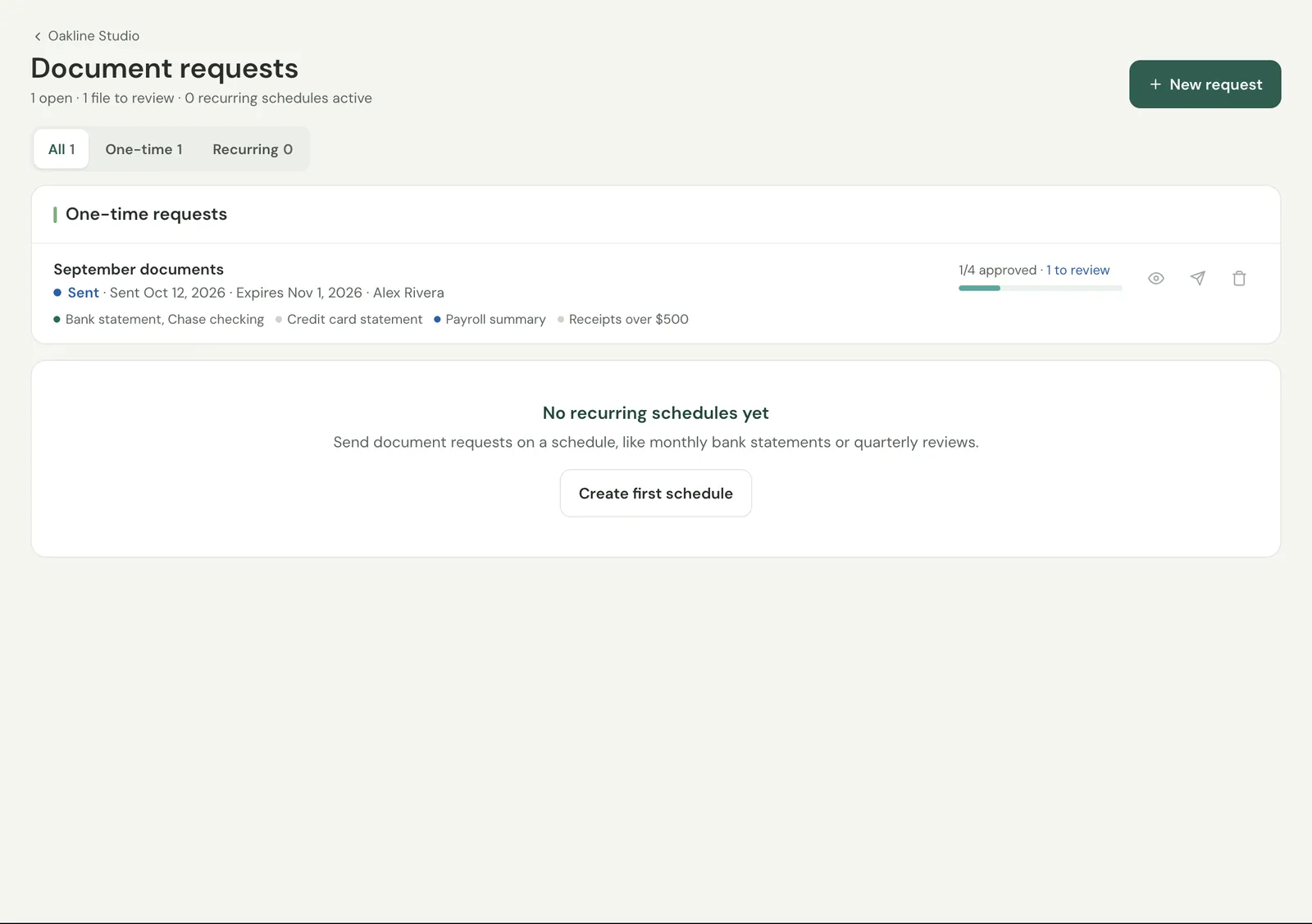
- One request list that chases itself. Send the year-end list as a document request. Clients upload from the client portal, reminders go out on their own and stop the moment the client sends what you need.
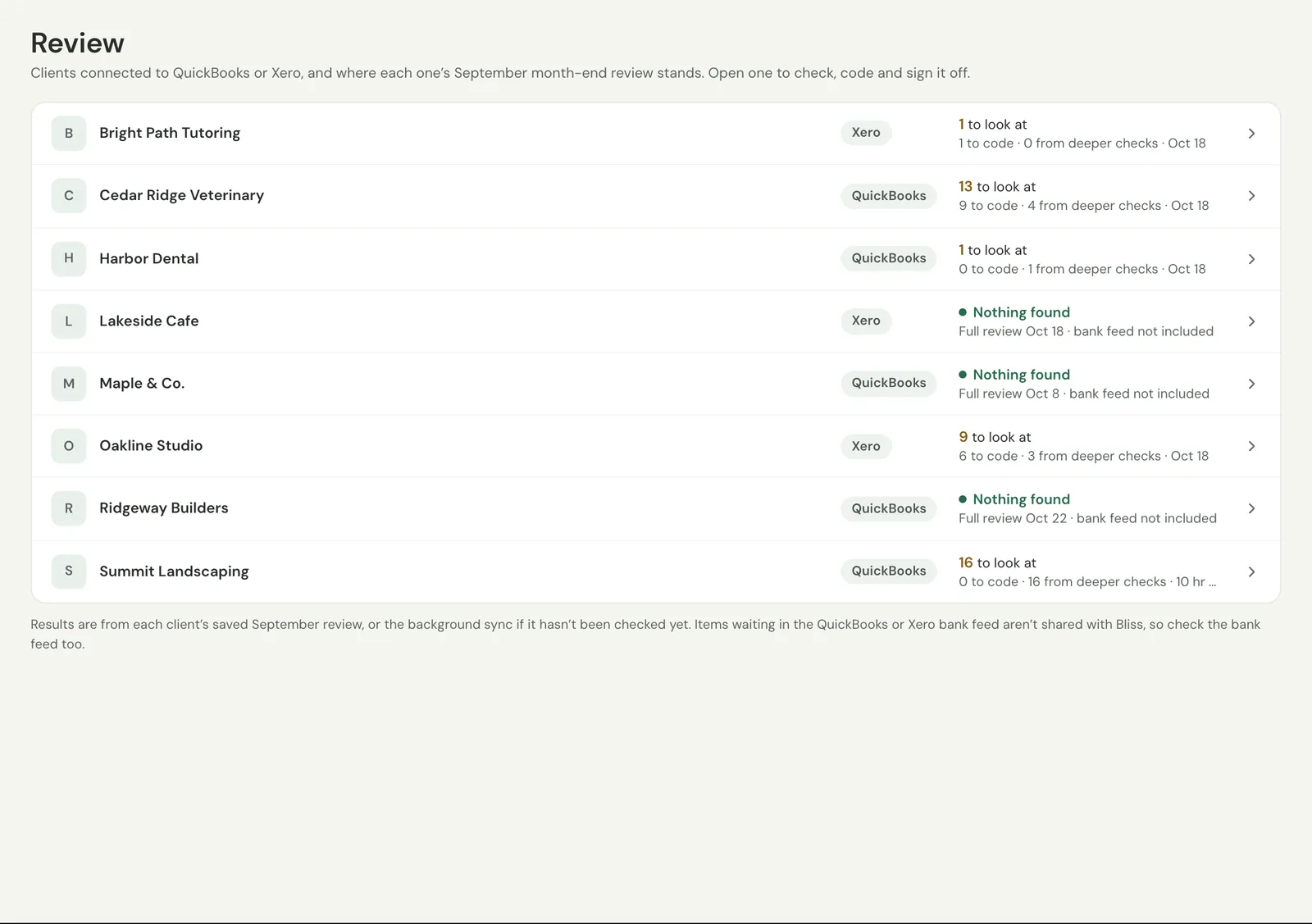
- One board for the December close. The Monthly close board shows every client's reconciliation, open questions and report in one place, then locks the period when you're done.
Start a free 30-day trial and set up your year-end jobs this week, while there's still time to send requests in November. The first 50 firms keep the Founding Firm price for as long as they stay subscribed.