 Bliss HQ
How to get bookkeeping clients from CPA referrals (with email templates)
A step-by-step way to build referral partnerships with tax-only CPAs and EAs, from finding the right firms to the four emails that get the first call, plus how to keep referrals coming both ways.
Ask a bookkeeping firm owner where their best clients came from and the answer is usually the same: a CPA sent them. Referred clients arrive already trusting you, they rarely haggle over price, and they stay longer than anyone who found you through an ad.
Yet most bookkeepers treat CPA referrals as luck. This guide treats them as a process you can run every month: who to approach, what to send, what to say on the first call and how to keep the referrals coming.
Why CPAs are the best referral source you have
Many CPAs and enrolled agents (EAs) focus on tax returns, planning and IRS work. Plenty of them don't offer monthly bookkeeping at all. Others offer it but don't have the time, or simply don't enjoy it.
Their clients still need clean books. Every spring they see the same problems:
- A business owner who arrives in March with a shoebox of receipts.
- A client whose books are a year behind after a letter from the IRS.
- A growing company that has outgrown doing its own QuickBooks.
Each of those is a bookkeeping client the CPA would gladly hand to someone they trust. And it works in reverse: your bookkeeping clients need a tax professional every year. That two-way flow is what makes the relationship last. A partner who only ever sends you work, and gets nothing back, eventually stops.
Step 1: Build a short list of the right firms
Not every CPA firm is a good partner. You want firms whose services sit next to yours, not on top of them.
Good signs on their website:
- Tax preparation and planning are the main services.
- Bookkeeping isn't listed, or is mentioned only in passing.
- They handle IRS problems, audits or back taxes. Those clients almost always need catch-up books.
- They serve small businesses, not only individuals.
Skip, or check first:
- Firms that sell monthly bookkeeping or "QuickBooks services" as a main offering. They're competitors, not partners.
- Firms that aren't taking new clients. A referral relationship still works, but they have less to send.
- Firms with a niche far from yours.
Start with 15 to 25 firms within driving distance. For each one, note the contact name and their credentials (CPA or EA), email, phone, city and one line on why they fit. That last line matters: it's what makes your first email sound like you actually looked at their firm.
Step 2: Send a short, specific first email
The first email has one job: get a reply or an open. Keep it short, say why the fit makes sense, and ask for one small thing: a 20-minute call.
Here are the four emails we use, written to send in sequence. Replace the parts in brackets.
Email 1: the introduction (day 1)
Subject: Referrals between [their firm] and [your firm]
Hi [first name], I'm with [your firm], a bookkeeping firm in [your city]. From your website it looks like [their firm] focuses on tax work and doesn't offer monthly bookkeeping. We're the opposite: we keep the books and don't prepare returns. That usually makes for a good referral relationship. Your clients who need their books cleaned up or kept each month are exactly who we help, and our clients always need a tax professional they can trust. Would you be open to a 20-minute call to see if it makes sense to refer clients to each other? [Your name and signature]
Email 2a: if they opened it (2 days after they open)
Subject: A quick call about referrals?
Hi [first name], Following up on my note about referrals. I'd like to set up a short call to learn what kinds of clients you'd like more of, and to share how we work, so we each know when to send someone over. If 20 minutes in the next week or two works, just reply with a time that suits you, or pick one on my calendar using the link below. [Your name, signature and booking link]
Email 2b: if they didn't open it (4 days after email 1)
Subject: Bookkeeping support for your tax clients
Hi [first name], I wanted to make sure my earlier note reached you. [Your firm] provides monthly and catch-up bookkeeping for small businesses in [your city], and we don't prepare tax returns. If you have clients whose books aren't ready at tax time, or who have fallen behind, we'd be glad to help them get caught up. We also refer our own clients to tax professionals we trust. Would you have 20 minutes for a call to talk it through? [Your name and signature]
Email 3: the last note (7 days later, only if they never opened anything)
Subject: Closing the loop
Hi [first name], I don't want to crowd your inbox, so this will be my last note. If a referral relationship with a bookkeeping firm would ever be helpful to [their firm], I'd welcome a short call whenever the timing is right. Just reply to this email and we'll find a time. [Your name and signature]
If they opened an email but haven't replied after a week, don't send another email. Pick up the phone. Someone who opened your note twice is curious. A friendly call ("I sent you a note about referrals last week, do you have a minute?") turns that curiosity into a meeting far more often than a fifth email.
A few rules that make these work:
- Send on weekdays, during business hours. Tax professionals read email at their desks.
- Avoid tax season for the first contact. From February to mid-April, most CPAs won't take a call. October to January and May to August are your windows.
- Stop the moment they reply. Nothing undoes goodwill faster than an automated follow-up landing after someone already answered you.
- Make replying easy. Include a calendar link in your signature so they can book the call without any back and forth.
Step 3: Use the 20-minute call to set up the hand-off
The first call isn't a sales pitch. You're both checking whether you'd be comfortable putting your reputation behind the other. Come with questions:
- What kinds of clients do you most want more of? Which do you turn away?
- Where do your clients' books usually go wrong?
- Do you have clients right now who are behind, or about to be?
- How do you like to make an introduction: email, a call, or a three-way meeting?
- Who do you usually send clients to when they need bookkeeping today?
Then share the same about your firm: who you serve, what a typical engagement looks like and what it costs, and how quickly you can start. Agree on how a hand-off works. A short email introducing both sides, copied to the client, is usually enough.
End by asking for one thing: "If a client comes up who needs catch-up books before tax season, would you send them my way?" A specific ask gets remembered.
Step 4: Keep the relationship warm
Most referral partnerships don't fail at the first call. They fade because nobody follows up. A simple rhythm prevents that:
- Check in every 90 days. A short call or coffee during the off-season, or an email with something useful.
- Thank every referral, every time. A handwritten card or a quick note after the client signs. Tell the CPA how it went.
- Send work back. When a client needs a tax preparer, refer them to your partner and say so. Nothing builds loyalty like a referral in return.
- Make their clients look good. Deliver clean, reconciled books before their deadlines. The CPA's year gets easier, and they notice.
- Know who's gone quiet. If a partner hasn't sent anyone in a few months, that's your cue to reach out, not to give up.
A note on referral fees
It's tempting to offer a percentage of the first year's fees. Be careful. CPAs and EAs follow professional rules (the AICPA Code of Professional Conduct, and Circular 230 for anyone who practices before the IRS) that can limit or require disclosure of referral fees, and some states add their own rules. Many tax professionals simply won't accept them.
A two-way referral relationship, where each of you sends the other work, is the safe default and usually the stronger one. If you do agree on a fee, put it in writing and let the CPA confirm it fits their rules.
Track it, or it won't last
Once you have more than a handful of partners, the hard part is remembering: who you emailed and when, who opened what, who you owe a call, who sent you a client last month and who hasn't sent anyone all year.
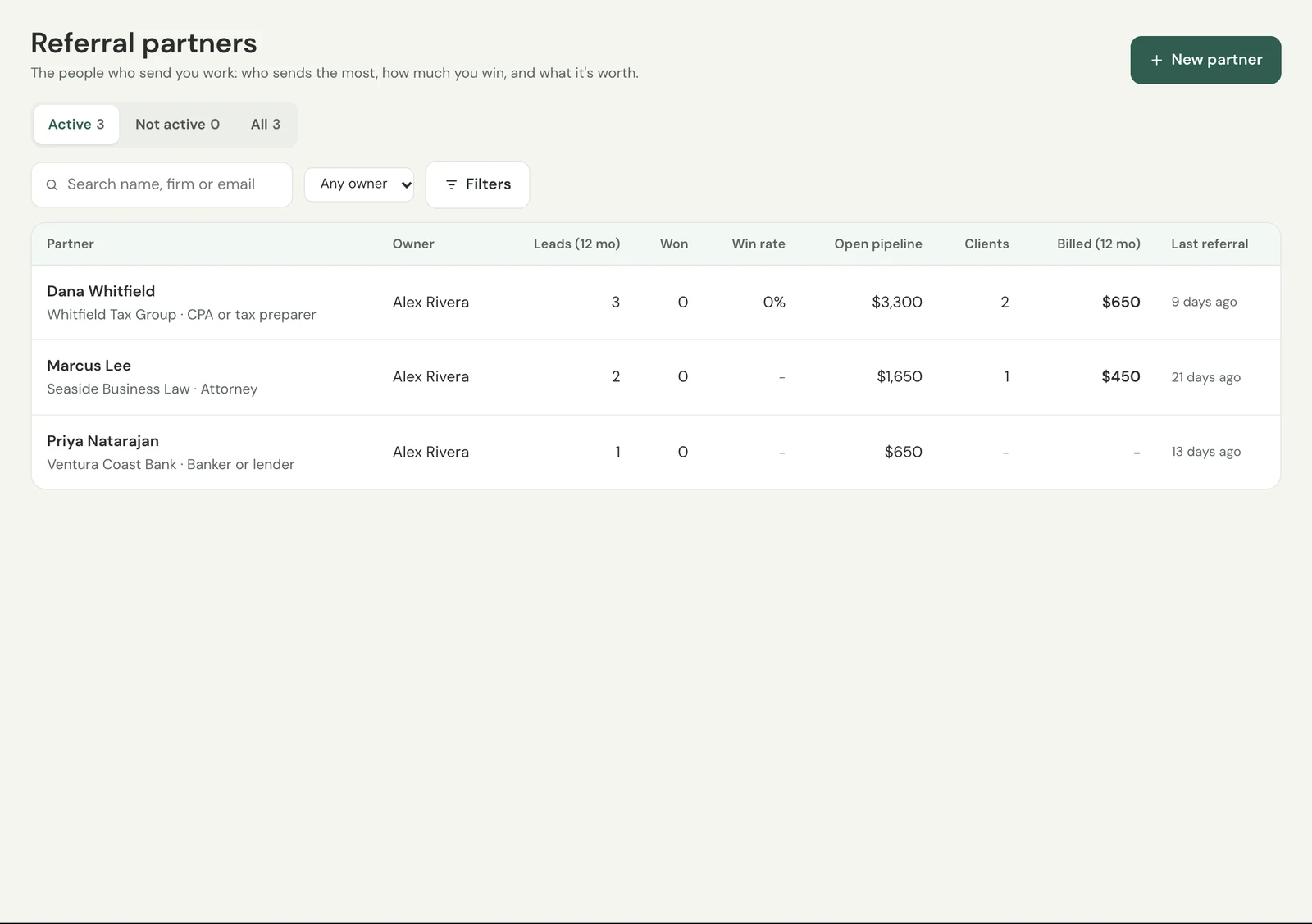
That's what referral partners in Bliss HQ is built for:
- Every partner in one list, with their contact details, their tier (prospective, active, quiet or champion) and the next check-in that's due.
- Email workflows that send the sequence above for you, branch on whether they opened it, create a "call them" task when someone shows interest, and stop automatically when they reply.
- A two-way referral ledger, so you can see what each partner has sent you and what you've sent them.
- Repeating check-ins and thank-you reminders, so warm partners stay warm.
It sits alongside the rest of your sales tools, like the CRM and pipeline and nurture emails, so a referred lead flows straight into a proposal and a new client.
Start a free 30-day trial to set up your first referral partners and send the CPA referral call workflow to your own list. The first 50 firms keep the Founding Firm price for as long as they stay subscribed.