 Bliss HQ
How to price bookkeeping services: hourly, fixed fee or value
A plain-English guide to pricing bookkeeping services, comparing hourly, fixed monthly fees and value pricing, with what to include and how to handle extra work.
Pricing is the decision that shapes everything else in a bookkeeping firm: which clients you attract, how hard your team works and whether growth makes you more profitable or just busier. There is no single right price, but there are better and worse ways to set one.
The three common models
Hourly
You track time and bill for it.
- Good for: cleanups and catch-up work where the scope is unknown, and one-off projects.
- The catch: you are paid less as you get faster, and clients hesitate to call because the meter is running.
Fixed monthly fee
One price per month for an agreed scope.
- Good for: recurring bookkeeping. Clients know what they will pay, and you are rewarded for being efficient.
- The catch: scope creep. If you do not define what is included, the fee slowly covers more and more work.
Value pricing
The price reflects the outcome for the client, not your effort: a monthly advisory meeting, a cash forecast, a lender-ready report.
- Good for: CAS and advisory work, where the client cares about decisions, not data entry.
- The catch: it needs confidence and a clear story about what the client gets.
Most firms end up using all three: fixed fees for monthly work, hourly or fixed quotes for cleanups, and value pricing for advisory.
What drives a fair monthly fee
Rather than guessing, price from the things that actually create work:
- Transaction volume: roughly how many bank and card transactions each month.
- Number of accounts: each bank, card, loan and merchant account needs reconciling.
- Complexity: inventory, classes or locations, sales tax in several places, payroll, grants.
- Responsiveness: a client who answers questions quickly costs less to serve.
- Reporting: a P&L by email is different from a reviewed package with commentary and a call.
Build a simple tier table from these, and price new clients the same way every time.
Write the scope down
The most useful sentence in any proposal is the one that says what is not included. List it plainly:
- Included: monthly reconciliations, categorization, a monthly report and one review call per quarter.
- Not included: catch-up work before the start date, payroll, tax returns and sales tax filings.
- Extra work: quoted before you start, at your published rate.
When the scope changes, send a short change proposal instead of quietly absorbing the work.
Raise prices without drama
- Review every client's fee once a year, on the anniversary of the engagement.
- Give 30 to 60 days' notice, and explain what has changed in their business.
- Offer a choice where you can: the same service at the new price, or a lighter service at the old one.
Make the numbers visible
You can only price well if you can see what each client really costs. Track time even on fixed-fee clients, compare it with the fee, and look at realization every quarter. The clients at the bottom of the list are the ones to re-scope or re-price.
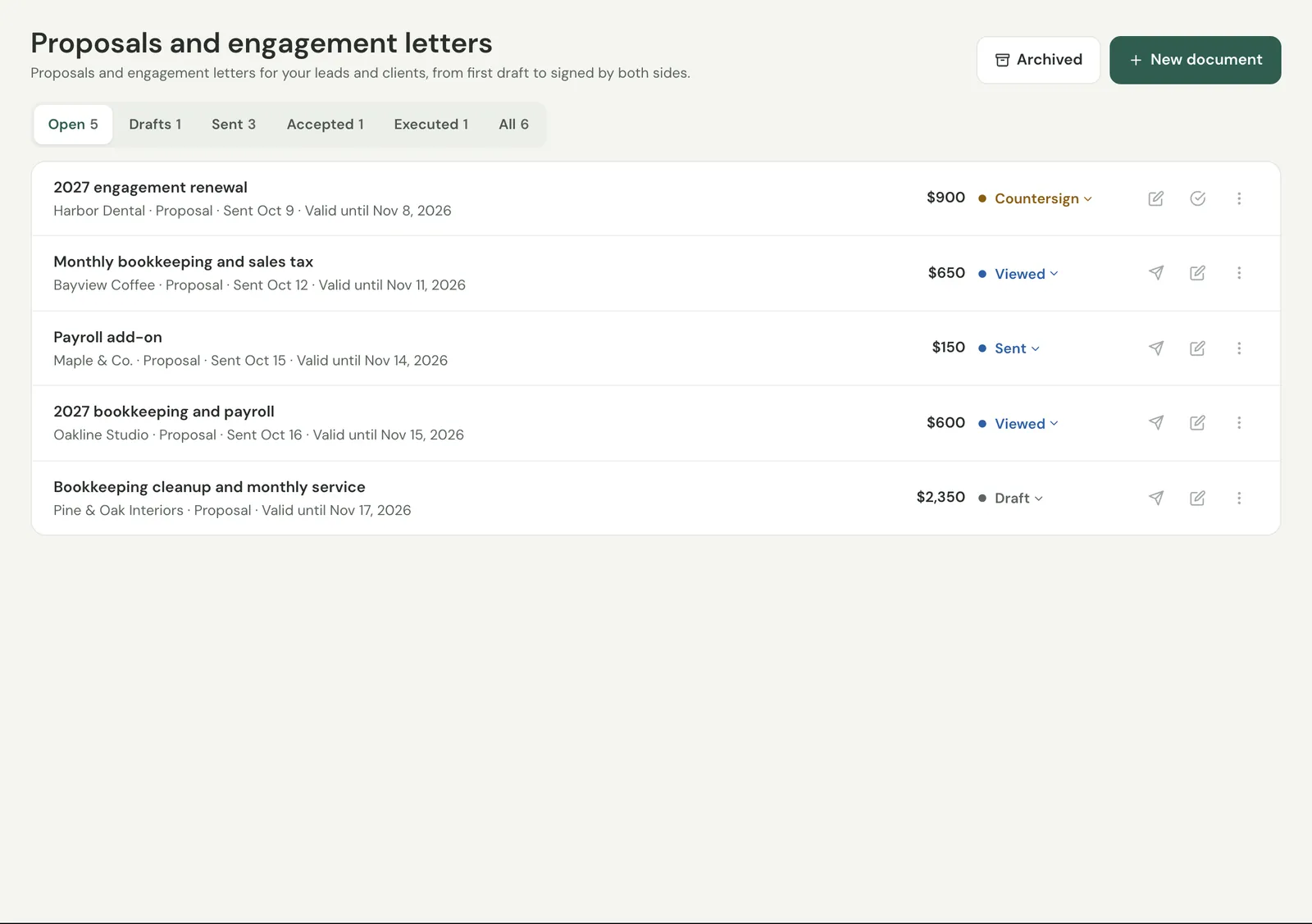
In Bliss HQ, proposals support fixed fees and recurring retainers in one document, signed proposals set up the engagement for billing automatically, and time and billing shows budget against actual for every client.